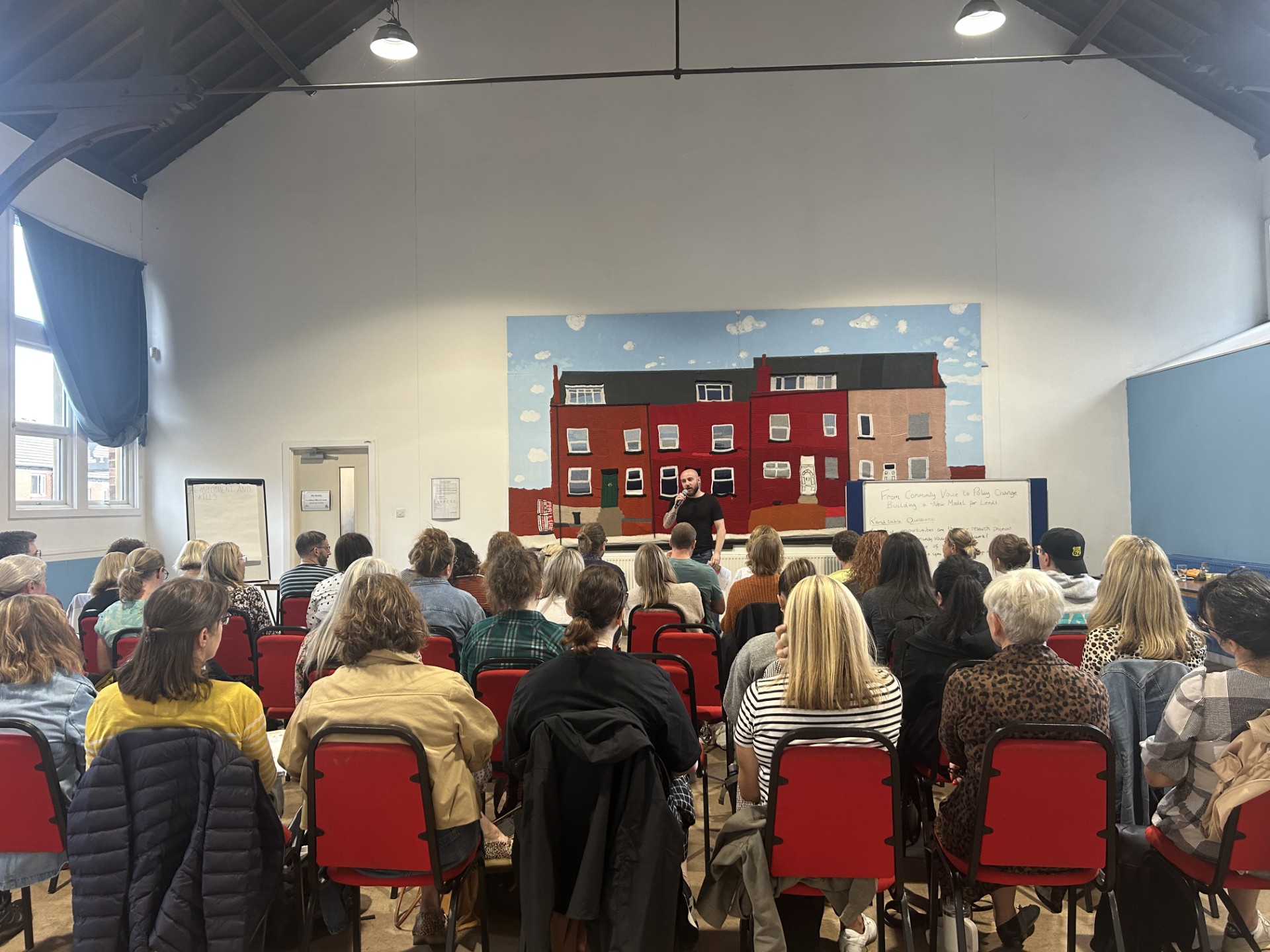
Over 50 representatives from the voluntary, community and social enterprise (VCSE) sector, universities, Leeds City Council and NHS partners came together for the latest LeedsACTS! event, From Community Voice to Policy Change: Building a New Model for Leeds.
The event focused on how community voices can play a greater role in shaping research, influencing policy and creating meaningful change across Leeds. Through presentations, networking and facilitated roundtable discussions, participants explored the findings of the Leeds Community Anchor Network (LCAN) Listening Exercise and discussed opportunities for stronger collaboration between communities, universities, statutory partners and policymakers.
Andrew Omond, Chair of LeedsACTS!, introduced attendees to the LeedsACTS! model, highlighting the policy pipeline and the role student research can play in helping organisations investigate local issues and influence decision-making.
Participants then heard from a range of speakers who demonstrated the value of community-informed research:
- Paul Barker (Space2/LCAN) spoke about the importance of community-led research in shaping policy and ensuring that lived experience is reflected in decision-making.
- Connor Craig-Jackson (VAL) shared key findings from the second year of the LCAN Listening Exercise.
- Grace Imri (Leeds City Council) highlighted the importance of community voice in developing local policy and how Areas of Research Interest (ARIs) can help policymakers address real-world challenges.
- Juliette Harrison (Leeds Beckett University) and Alexa Ruppertsberg (University of Leeds) discussed how universities can align research agendas with community priorities and create scalable, impactful partnerships through approaches such as student research projects.
Following a lively networking break and a round of bingo, participants moved into themed discussion groups.
Roundtable Discussions
Discussions were structured around three key themes emerging from the LCAN Listening year 1 report (LCAN Listening Exercise evaluation_)
1. Belonging and Discrimination
2. Skills and Employment
3. Communication and Visibility
Across six tables, participants shared experiences and explored how research could be used to support more equitable outcomes for communities.
Theme 1: Belonging and Discrimination
A strong message across discussions was that communities do not simply need a “voice” given to them. Instead, organisations and institutions must create spaces where people can genuinely influence decisions.
Participants discussed:
- The importance of people feeling heard, particularly within health systems.
- Ensuring children and young people’s voices are included in decision-making.
- The realities of discrimination experienced by many communities and how these experiences shape trust in institutions.
- The role of relationships and networks in creating belonging.
- The need to rethink the concept of partnership, recognising that collaboration often requires significant time and capacity from community organisations.
There was a strong focus on power and decision-making, with attendees questioning how more power can be transferred from large institutions to communities themselves.
Other key points included:
- Supporting students to engage more meaningfully with communities beyond academic requirements.
- Recognising community spaces as important settings for public service delivery.
- Challenging traditional research approaches when they reinforce inequalities or ask the wrong questions.
- Developing closer relationships between academics and communities so research responds to real-world issues rather than institutional priorities.
Theme 2: Skills and Employment
Conversations around skills and employment focused heavily on participation, opportunity and the role that research can play in understanding what works.
Participants highlighted:
- A lack of work experience and employment opportunities for young people.
- Questions about equity in access to employment pathways.
- The transition from university into meaningful employment.
- The importance of valuing volunteering and lived experience.
Several attendees shared examples of local interventions, including retail-based work placements and community employment projects, that have demonstrated positive outcomes but would benefit from stronger research and evaluation support.
A recurring theme was that many VCSE organisations are already undertaking evaluation and learning activities but do not necessarily describe this work as research.
Participants discussed opportunities for:
- Universities to provide research and evaluation capacity for community organisations.
- Better understanding which interventions are most effective and why.
- Replicating successful approaches across Leeds and beyond.
- Exploring new models of co-investigation where community members are active partners in research.
One table also focused on the language used within policy and research. Participants questioned terminology such as NEET (Not in Education, Employment or Training), highlighting concerns that such labels can reinforce exclusion rather than support understanding.
The group encouraged researchers and policymakers to challenge assumptions, involve communities in defining priorities and produce outputs that are practical, accessible and action-oriented.
Theme 3: Communication and Visibility
Communication and visibility generated discussions about trust, engagement and ensuring that community voices lead to meaningful change.
Participants explored:
- The different ways people define community.
- The distinction between communities of place and communities of interest.
- The inequalities created when some voices are easier to reach than others.
- The importance of understanding who is disconnected from communication and why.
Many attendees emphasised the importance of trusted places, trusted organisations and trusted people in facilitating engagement.
Examples were shared of research projects involving refugees, asylum seekers and communities experiencing health inequalities, where community involvement had directly influenced service design and delivery.
Discussions also highlighted:
- The importance of making research findings accessible and actionable.
- Challenges around language, particularly where terminology may create barriers or stigma.
- The crucial role of first points of contact in public services.
- The need to demonstrate the cost of poor engagement and communication as well as the benefits of getting it right.
Participants reflected on a common challenge: how to ensure research findings lead to real action rather than remaining as reports on a shelf.
Key reflection: Effective communication is not simply about sharing information. It is about building trust, reducing barriers and ensuring research drives practical change.
Next steps…
The event demonstrated the value of bringing together community organisations, researchers and policymakers to discuss shared challenges and opportunities.
The conversations generated new connections, fresh ideas and a clear commitment to ensuring that research in Leeds is shaped by the communities it seeks to serve. LeedsACTS! will continue to build on this work, creating opportunities for partners to collaborate, develop evidence and strengthen the link between community voice and policy change.
Thank you to all speakers, facilitators and participants who contributed to an engaging day.